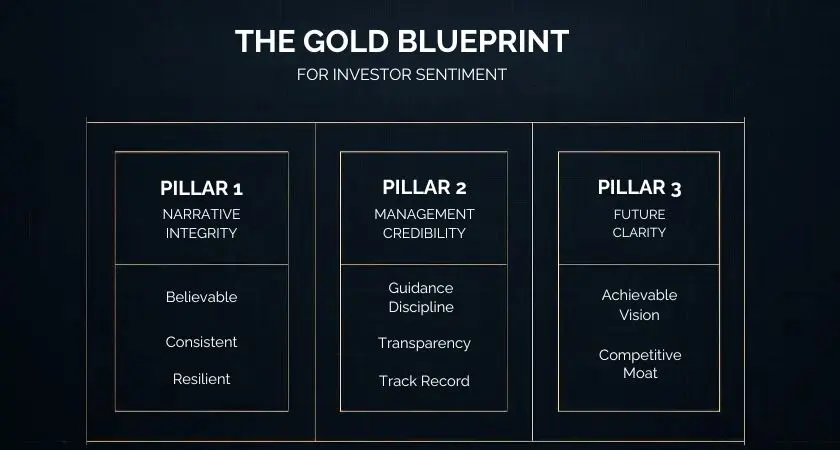
Three consecutive earnings beats. Revenue growth ahead of guidance. A management team that delivers on every strategic promise. Yet your stock trades flat while competitors with inferior fundamentals command valuations that make your board question everything.
Sound familiar? You’re not alone—and you’re not victims of an “irrational market.” You’re experiencing the costly reality of unmanaged investor sentiment. Here’s how to take control.
The Undervaluation Enigma: When Strong Performance & Poor Sentiment Collide
After twenty years evaluating public companies as an institutional investor, I’ve witnessed this disconnect countless times. CEOs assume strong fundamentals automatically translate to positive investor sentiment. They deliver solid quarterly results, maintain clean balance sheets, and expect the market to reward their operational excellence.
The uncomfortable truth: mismanaged sentiment isn’t just a perception issue. It has a real dollar cost.
Investor sentiment directly impacts your valuation multiple, cost of capital, and strategic flexibility. A company trading at 12x earnings versus a peer at 18x isn’t just missing market recognition—it’s missing perhaps hundreds of millions in market cap and limiting future growth options.
Consider the hidden costs of poor sentiment management:
- Valuation discounts of 20-40% compared to peers with strategic narratives
- Increased stock volatility as confused investors trade on uncertainty
- Limited access to capital when growth opportunities arise
- Board pressure that escalates with each quarter of flat performance
- Management credibility erosion that compounds market skepticism
The most damaging assumption? That “the market will eventually figure it out.” In my experience, markets don’t reward patience—they reward clarity, consistency, and conviction. Companies that wait for fundamentals to speak for themselves often wait forever.
Investor sentiment isn’t an abstract concept. It’s a measurable, manageable strategic asset that directly influences whether your stock trades at a discount or premium to intrinsic value.